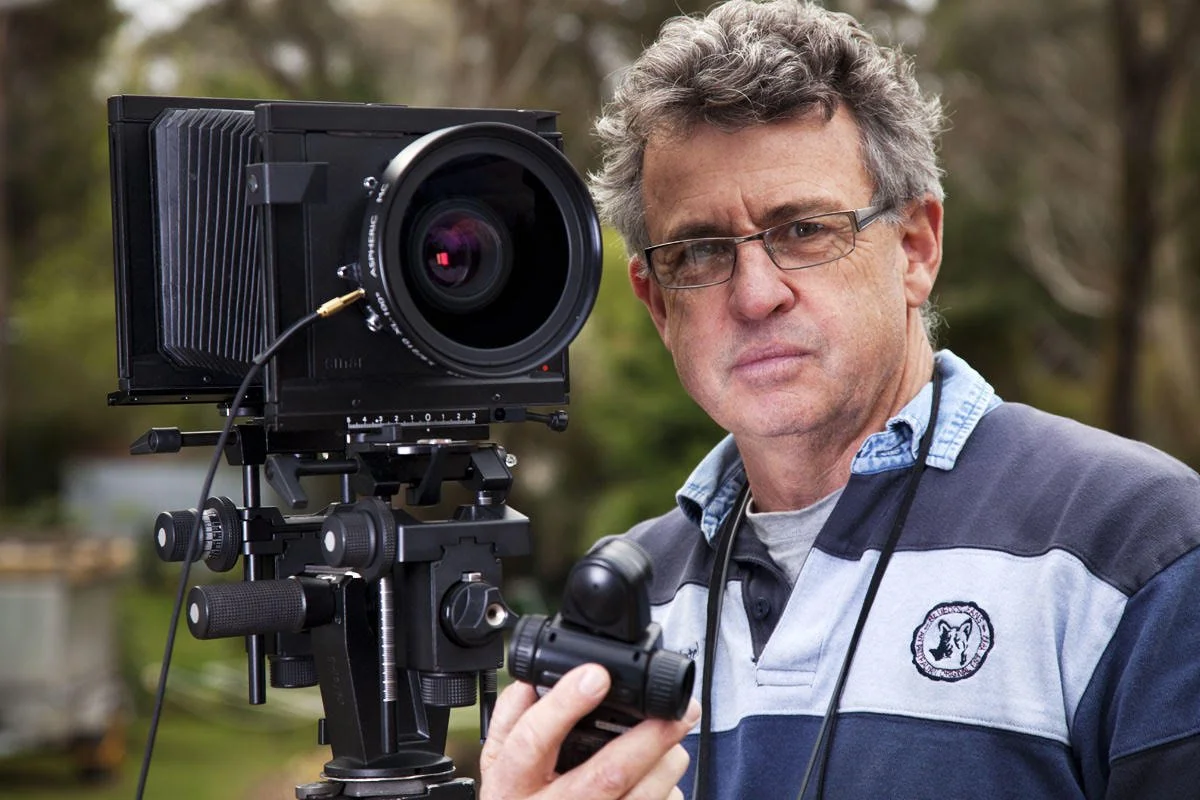
Anthony Lewis
Cinematographer – Astronomer - Photographer
Cinematographer
I worked as a freelance cameraman shooting stories and documentaries for TV production companies and directly the Australian television networks. Every day was a new location and I travelled the length and breadth of Australia and often the world. The cameras in the early days were all 16mm film, the German made Arriflex 16SRII being my constant companion and the best documentary camera ever made. The 1990’s saw the transition to electronic cameras.
A snapshot of the most memorable and significant stories:
The apartheid regime of South Africa in 1976
The Rhodesian (now Zimbabwe) / Mozambique War, 1976.
A Norman Gunston series travelling Australia in a DC3 ,1980.
China, 1985, “Reform and Opening Up”
Aung San Suu Kyi of Burma in 1989 (now Myanmar).
Stationed in Kandahar 2008, the Afghan war, flying all night missions.
Astronomer
Close to retirement I embarked on seven years of intense study which resulted in being awarded a Master of Science (Astronomy) from Swinburne University of Technology. I worked as an Astronomy Educator at Sydney Observatory and was the oldest guy in a cohort of young post-grad university and PhD students who brought these observational domes to life every night of the week with stargazing tours. They were more than fun to work with, incredibly bright and skilled and made me proud that this country has educated such youthful and intellectual talent. The astronomy tours ceased in 2020 due to a huge increase in light pollution in this part of the city. It was meant to be a Dark Skies declared area but due to developers and politicians (accepting bottles of wine) that didn’t happen. Sadly, this historic 1858 building was established as the first centre for scientific research in Australia. We were the last to see it as a working museum.
Photographer
With my last hurrah now upon me, I have reverted to a craft that I most admire, that of still photography where just one well composed image ‘tells a thousand stories’. Having learnt the trade on large format film cameras (4x5 inch negatives), I now shoot with the latest in digital mirrorless camera technology and auto-focus lenses.
A knowledge of Astronomy has led me into the art of Infrared photography, a light spectrum not visible to the human eye. Yet, humanities now most famous telescope, the James Webb Observatory now in orbit around the Sun (not Earth), is purely an infrared instrument. An infrared photograph illuminates our world in a different light.
I am attracted to the old printing processes of yesteryear, for example, the platinotype process where the noble metals, palladium and platinum are embedded into the printing paper that produces a subtle dreamy mono-tonal sepia image, a photograph that will last a thousand years. This is a work in progress and hopefully have some photos shortly.
My Equipment
The latest Canon mirrorless cameras with the famed Canon RF USM L series prime lenses. For infrared photography I use Canon’s STM lenses (they are free of infrared hotspots). I believe in using a tripod whenever possible, even though the lenses and camera have stabilisation. Prime lenses are faster, narrower depth of field, smother bokeh and sharper. They are more cumbersome to work with, but I live with the better result.
Contact
tonyhughlewis@gmail.com
Australia, 0418 612 434
Web: anthonylewis.photos
(Note: No ‘www’ and no other suffix)
Follow